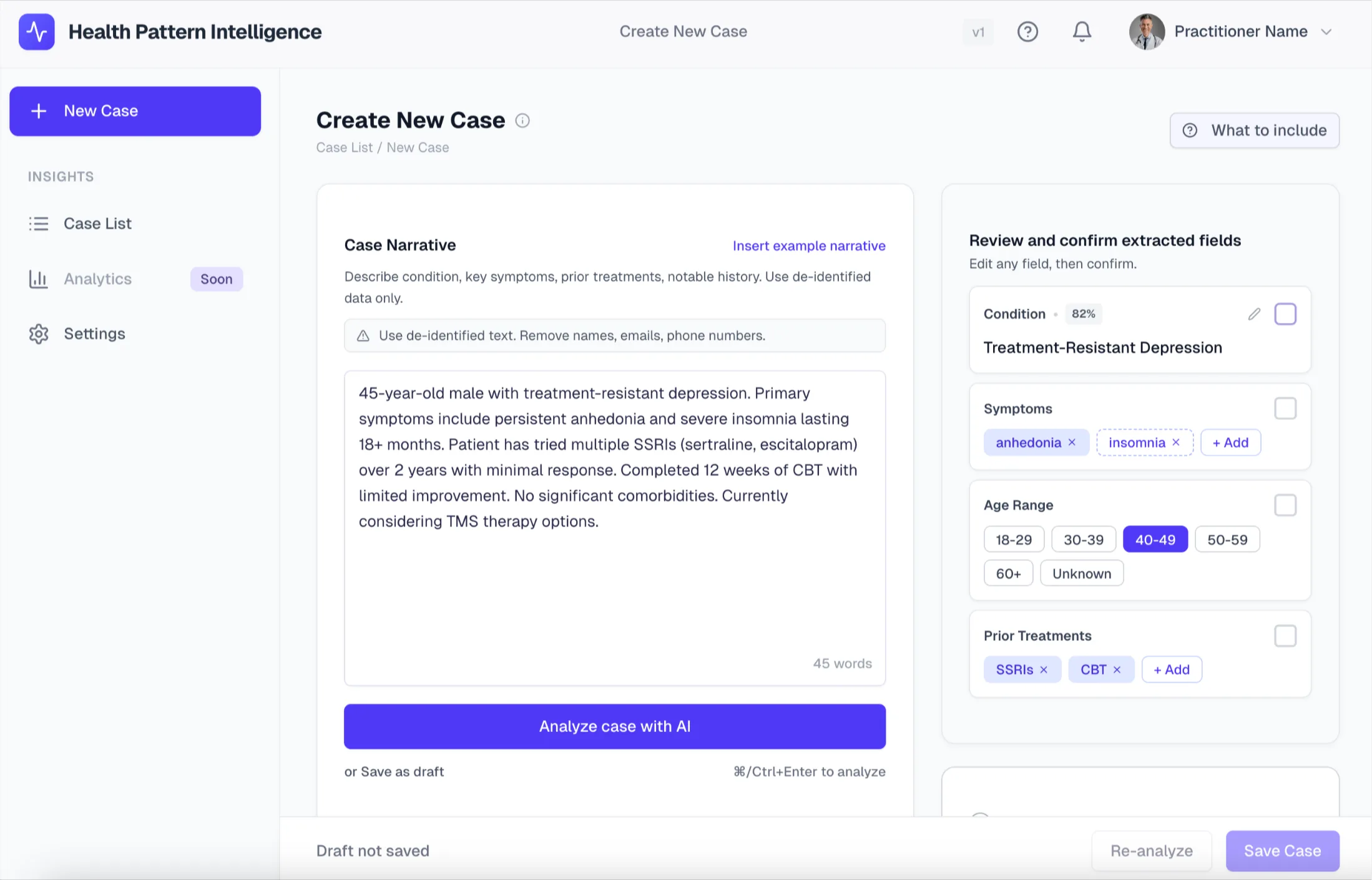
Prototyping an AI-Assisted
Clinical Decision Support
Platform for Mental Health
Context
Mental health professionals diagnosing Personality Disorders must process dense, qualitative patient histories — making it incredibly difficult to track clinical progress over time. Our client, a pioneering US-based HealthTech startup, envisioned a specialised Clinical Decision Support System (CDSS) that leverages AI to help clinicians manage this complexity and improve diagnostic accuracy.
Building an AI-native medical platform from scratch is highly capital-intensive. Before committing to full-scale development, the client needed to secure stakeholder and investor alignment with a convincing, interactive prototype.
“The challenge was to make a prototype feel like a fully coded product — convincing enough to validate the concept with investors before a single line of backend code was written.”

The Challenge
Visualizing Complex AI in Clinical Workflows
Complexity of Mental Health Data
Personality Disorder diagnosis requires processing dense, qualitative patient histories that evolve over months. Clinicians needed a system that surfaces relevant patterns — not raw data dumps.
Clinical UX · Data Density
Clinician Trust in AI
Mental health professionals are deeply sceptical of AI "replacing" their judgment. The interface had to present AI insights as a collaborative assistant — supporting, never overriding, clinical expertise.
AI Trust · Human-Centred Design
Prototype Must Feel Like a Product
Without a backend, Figma had to simulate live logic — functional filters, dynamic case states, real-time-feeling AI outputs — convincingly enough to pass investor scrutiny.
Figma Prototyping · Investor Readiness
Pre-Development Validation
The client needed to validate desirability and secure funding before committing to a multi-year backend build — making the prototype the single most important deliverable.
Stakeholder Alignment · De-risking
Solution — Two Core Design Tracks
Intelligent Case Management
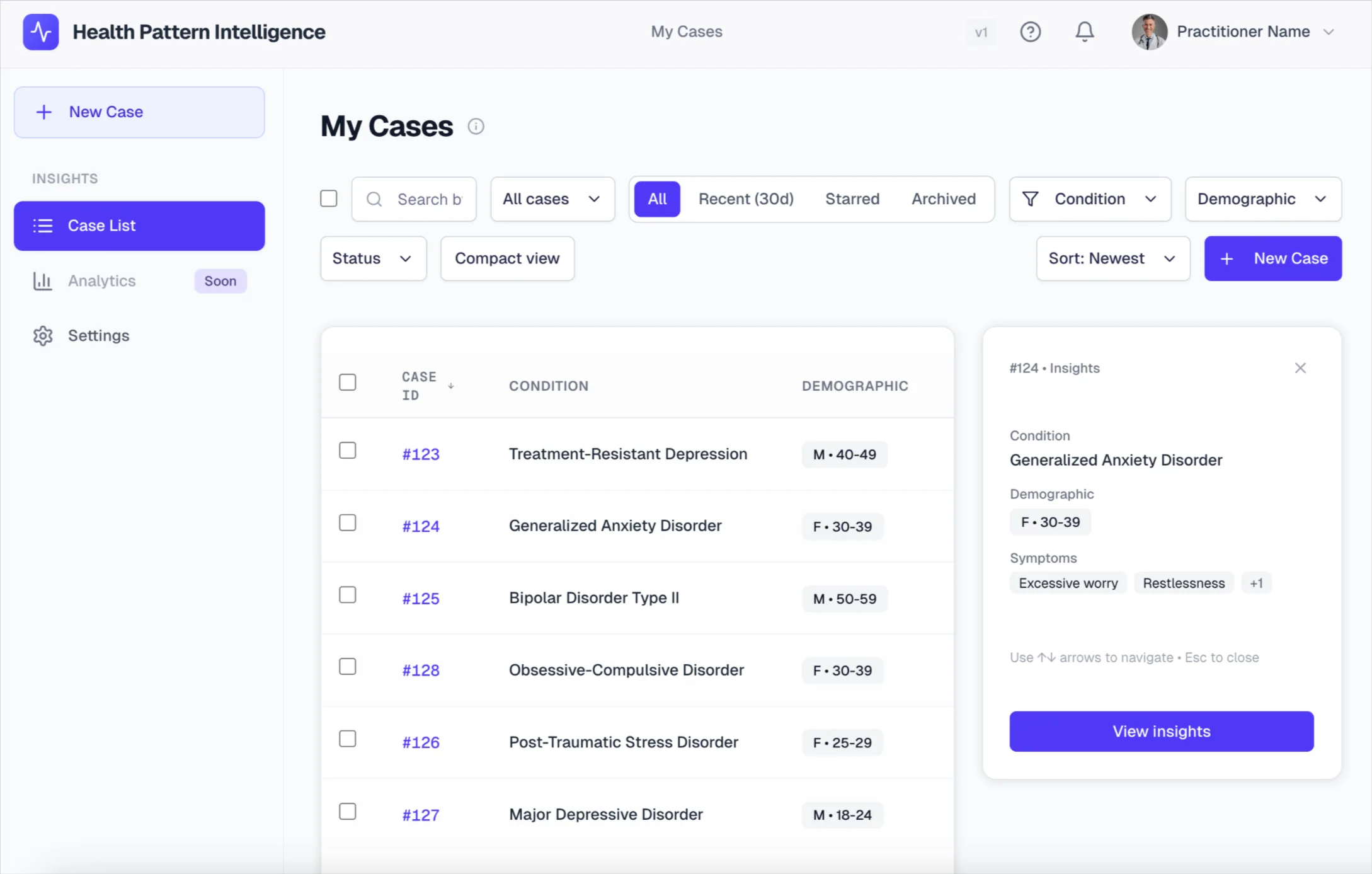
Command DashboardWe designed a centralised command dashboard where practitioners can view their entire patient load at a glance. The prototype simulated live logic to make filtering and case management feel like a fully coded product.
- Dynamic filtering by diagnostic urgency with functional checkbox states
- “Recent” view filtered to last 7 days of patient activity
- Priority starring system with complex multi-state component logic
AI Decision Support Interface
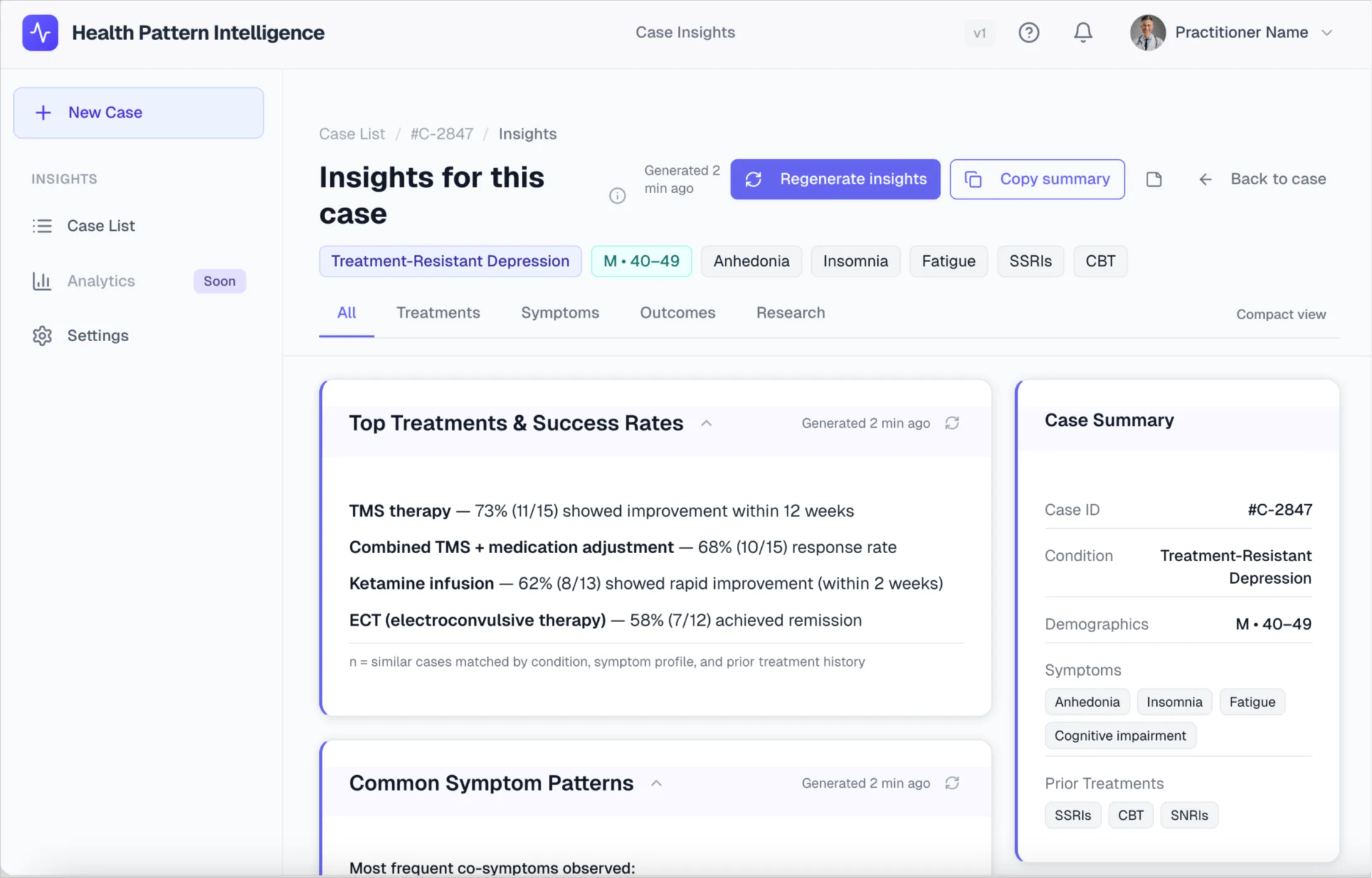
Collaborative IntelligenceThe core value proposition is the intelligence engine. We designed the interface to present AI-generated insights — extracted symptom patterns, similar case outcomes, top treatment recommendations — directly alongside traditional clinical notes in a side-by-side layout that builds trust rather than replacing judgment.
- AI insights panel presented alongside, never replacing, clinician notes
- Extracted symptom patterns and similar case references surfaced contextually
- Designed specifically for Personality Disorder nuance — not generic AI output
What We Designed
Every feature was engineered to balance clinical utility, AI transparency, and investor confidence.
Dynamic Case Filtering
Functional urgency filters and status checkboxes simulated in Figma — felt like live product logic to clinician testers.
Recency-Based Views
Dedicated "Recent" view surfacing only the last 7 days of patient activity, reducing cognitive load for busy practitioners.
AI Insight Panel
Side-by-side AI recommendations alongside clinical notes — symptom patterns, similar cases, and treatment references in context.
Priority Starring System
Multi-state star/unstar component with seamless Figma logic — prototype-level interaction indistinguishable from coded behaviour.

Business Impact
The prototype allowed the client to validate desirability and secure stakeholder buy-in before writing a single line of backend code.
required to secure investor alignment — the prototype alone demonstrated the full product vision
deeply interactive prototype allowed the founding team to demonstrate end-user experience at pitch stage
interface specifically tailored for Personality Disorder nuance — validated by clinical stakeholders as accurate
Built for Clinical Trust
Every design decision was made with the clinician's cognitive load in mind. AI insights were positioned to augment, never replace, professional judgment — a critical design principle in regulated mental health environments.
Prototype-First Strategy
By validating with a high-fidelity prototype before backend investment, the client de-risked millions in development spend and accelerated their path to funding.
Confidential Client
HealthTech Startup, USA
NDA-protected engagement. Client details and branding are anonymised at their request.
Need to Validate Before You Build?
At MaxyLogic, we design high-fidelity prototypes that validate your clinical vision, secure investor buy-in, and de-risk your path to full-scale development.